
Persist
Orchardgrass
It's gonna be around for a long time.
If you want an orchardgrass that will last, even under intense grazing pressure, look no further than Persist orchardgrass! Persist orchardgrass was specifically selected for long-term performance and persistence under grazing.
Find a dealerGrazing Data
Yield Data
Forage Quality
Data from multiple trials confirm that Persist's nutritional quality is just as good as its ability to survive.
Pennsylvania
Penn State University
Penn State Nutrition Quality
Rock Springs, PA
|2005
| Variety | Protein | ADF | NDF |
|---|---|---|---|
| Barexcel | 15.6 | 26.7 | 56.5 |
| Persist | 14.9 | 27.4 | 57.4 |
| Command | 14.7 | 28.4 | 57.8 |
| Bounty | 15.4 | 27.1 | 58.0 |
| Niva | 15.4 | 28.2 | 58.5 |
| Century | 15.1 | 27.0 | 58.3 |
| Pennlate | 15.1 | 27.2 | 58.3 |
| Extend | 14.6 | 27.6 | 58.5 |
| Shiloh II | 14.8 | 28.2 | 59.5 |
| Haymaster | 13.2 | 30.0 | 60.9 |
| Athos | 130 | 32.9 | 61.9 |
| Barlemas | 13.5 | 31.7 | 62.0 |
| Measured with NIR. | |||
Wisconsin
Wisconsin State University
Palatability Rating (1-5)*
Lancaster, WI
|2006
| Variety | Species | May 5 | Jun 8 | Jul 2 | Sep 9 | Nov 1 | Average |
|---|---|---|---|---|---|---|---|
| Persist | Orchardgrass | 3.0 | 4.0 | 4.0 | 2.8 | 3.8 | 3.7 |
| Felopa | Festulolium | 3.6 | 3.0 | 3.4 | 3.3 | 3.4 | 3.3 |
| Agula | Festulolium | 3.4 | 3.0 | 3.6 | 3 | 3.8 | 3.2 |
| Harverster | Orchardgrass | 3.0 | 3.2 | 3.2 | 3.3 | 3.8 | 3.1 |
| Matrix | Festulolium | 3.4 | 2.4 | 3.2 | 3 | 3.3 | 3.1 |
| Sulino | Festulolium | 3.6 | 2.8 | 3 | 2.8 | 3.5 | 3.1 |
| *PALAT. = Palatability rating 0=0% grazed, 1=20%, 2=40%, 3=60%, 4=80%, 5=100% grazed. Palatability of grasses under grazing is determined by visual estimation of percent defoliation of plots. The visual determination is made midway during mob grazing by beef cows of the grass plots for intake determination. | |||||||
| Lsd = 0.5 | |||||||
Missouri
Ozark Empire Fair Hay Contest
Dry Hay Class - Cool-Season Grasses
Multiple Locations
|2023
| Entry | Location | Cut Date | RFQ | RFV | ADF | NDF | NEL | TDN | CP |
|---|---|---|---|---|---|---|---|---|---|
| Cajun II Fescue | Clever, MO | 4/11/2023 | 208.00 | 156.00 | 22.00 | 42.75 | 0.72 | 69.82 | 20.60 |
| Persist Orchardgrass | Purdy, MO | 4/28/2023 | 166.00 | 123.00 | 28.22 | 50.52 | 0.66 | 64.68 | 13.50 |
| Kentucky 31 Fescue/Orchardgrass | Aurora, MO | 7/15/2023 | 132.00 | 114.00 | 29.78 | 53.75 | 0.64 | 63.39 | 13.80 |
| Kentucky 31 Fescue | Verona, MO | 5/20/2023 | 110.00 | 97.00 | 34.86 | 58.93 | 0.60 | 59.20 | 11.40 |
| Kentucky 31 Fescue | Billings, MO | 5/20/2023 | 109.00 | 96.00 | 34.74 | 59.91 | 0.60 | 59.30 | 10.60 |
| Smooth Brome Mix | Strafford, MO | 5/24/2023 | 107.00 | 96.00 | 34.39 | 59.94 | 0.60 | 59.59 | 10.10 |
| Cow Pro Fescue | Sheldon, MO | 6/13/2026 | 106.00 | 95.00 | 35.23 | 60.03 | 0.59 | 58.86 | 7.80 |
| Annual Ryegrass/Orchardgrass | Verona, MO | 5/30/2023 | 91.00 | 87.00 | 37.32 | 64.26 | 0.57 | 57.17 | 9.00 |
| Kentucky 31 Fescue | Jenkins, MO | 5/24/2023 | 87.00 | 83.00 | 40.00 | 64.38 | 0.55 | 55.00 | 9.30 |
| Kentucky 31 Fescue | Sheldon, MO | 6/14/2023 | 81.00 | 79.00 | 39.86 | 67.84 | 0.55 | 55.07 | 9.40 |
| Average - 10 entries | — | — | 120.00 | 103.00 | 33.64 | 58.23 | 0.61 | 60.21 | 11.50 |
| See full results. | |||||||||
Ozark Empire Fair Hay Contest
Dry Hay Class - Cool-Season Grasses & Legumes
Multiple Locations
|2023
| Entry | Location | Cut Date | RFQ | RFV | ADF | NDF | NEL | TDN | CP |
|---|---|---|---|---|---|---|---|---|---|
| WL 357 Alfalfa/Benchmark Orchardgrass | Monett, MO | 6/28/2023 | 187.00 | 171.00 | 27.78 | 36.67 | 0.69 | 67.56 | 17.40 |
| Cimaron Alfalfa/Persist Orchardgrass | Purdy, MO | 7/1/2023 | 163.00 | 132.00 | 28.55 | 46.90 | 0.68 | 66.70 | 19.70 |
| VNS Alfalfa/Hallmark Orchardgrass | Billings, MO | 6/18/2023 | 160.00 | 134.00 | 32.98 | 43.78 | 0.63 | 62.01 | 17.70 |
| WL 359 Alfalfa/Annual Grass | Aurora, MO | 6/12/2023 | 156.00 | 136.00 | 30.51 | 44.46 | 0.66 | 64.64 | 20.30 |
| WL 365 Alfalfa/Persist Orchardgrass | Aurora, MO | 6/18/2023 | 152.00 | 132.00 | 30.16 | 46.16 | 0.66 | 65.02 | 18.00 |
| Ameristand Alfalfa/Crabgrass | Ozark, MO | 7/10/2023 | 151.00 | 129.00 | 30.67 | 46.88 | 0.66 | 64.48 | 15.90 |
| Red Clover/Orchardgrass | Purdy, MO | 7/9/2023 | 141.00 | 127.00 | 30.04 | 48.05 | 0.64 | 63.18 | 13.60 |
| Venus XDT Alfalfa/Crown Royal Orchardgrass | Houstonia, MO | 5/24/2023 | 116.00 | 108.00 | 35.92 | 52.29 | 0.59 | 58.88 | 15.20 |
| Orchardgrass/Fescue/Red Clover | Crane | 5/25/2023 | 98.00 | 95.00 | 38.59 | 57.59 | 0.56 | 56.12 | 10.90 |
| Average - 9 entries | — | — | 147.00 | 129.00 | 31.69 | 46.98 | 0.64 | 63.18 | 16.50 |
| See full results. | |||||||||
Persistence
Tennessee
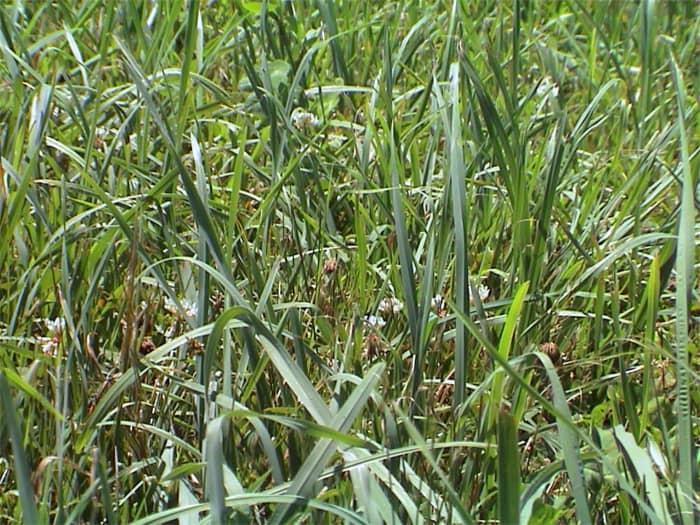
Some of the most significant data has come from a persistence study conducted at the Ames Plantation in SW Tennessee where a comparison grazing study was conducted with Persist and a well-known orchardgrass. Both varieties were planted in separate pastures, with and without clover.
After an intense drought and stressed period in 1999, two years after the began, there was a dramatic difference in the performance of the two cultivars. The other variety simply could not handle or recover from the stress. Persist, on the other hand, continued to not only survive but to provide good, healthy stands of grass, even when the clover died out in the third year.
Observations
The following are the recorded observations of the University of Tennessee research team:
Spring 1997
All pastures seeded in a pure stand of orchardgrass are well established, with no visible difference with regard to variety. The grass is too tall and the stands too thick to make quantitative estimates. All the orchardgrass-clover mix pastures have about the same grass-clover ratio.
Spring 1998
The orchardgrass-clover pastures have about a 50:50 ratio of grass-clover. Pure orchardgrass pastures appear to be equal.
Summer 1999
One of the Persist-clover and one of the other variety/clover pastures has a decrease in clover to about 30%. The clover in one of the Persist pastures has increased to about 60%.
Fall 1999
All pastures show drought stress. Pastures with clover appear better than those with orchardgrass as a pure stand. Pastures with Persist in a pure stand are superior to those with the other variety in a pure stand.
Spring 2000
Persist pastures in a pure stand have a good stand of grass. The other variety pastures in a pure stand are thin and have little available grass. The other variety pastures with clover have a loss of grass. The grass in these pastures appears stressed and is not as green as those with Persist.
Fall 2000
Clover has been lost in all pastures that were originally seeded with clovers. Orchardgrass stands are approximately 70-80% in Persist Pastures seeded without clover and 0-10% in the other variety's pastures seeded without clover.
Spring 2001
Stands of Persist in pastures seeded without clover is about 80%. The stands of the other variety (also seeded without clover) are less than 10%.
Canada
In 2007 Persist was planted at five trial sites throughout Nova Scotia and Prince Edward Island on the far east side of Canada. Using a series of statistical calculations, the researchers evaluated Persist and the other entries to determine persistence. The value generated from these calculations is then used to help determine if the entered varieties would be approved for sale in Canada. It is also a measurement they use to compare varieties to one another, even if they were tested in different years.
Not only did Persist pass the test with flying colors and is now approved for sale in Canada, but Persist's "Percent Persistence" score is now the HIGHEST of all the US commercial varieties entered in their trials since 1990 and superseded only by a Swedish variety. Not bad for a Tennessee-bred orchardgrass, eh?
Persistence Cumulative Scores
Orchardgrasses seeded from 1990-2011
| Variety | Persistence Score |
|---|---|
| Dactus | 7.1 |
| Persist | 6.3 |
| Niva | 5.6 |
| Frode | 5.0 |
| Okay | 2.8 |
| Kay | 0.4 |
| Crown Royale | -1.4 |
| Okamidor | -2.2 |
| Jay | -2.3 |
| Baridana | -3.2 |
| AC Nordic | -3.8 |
| AC Splendor | -3.8 |
| Lidacta | -7.5 |
| Artic | -8.9 |
| Intensiv | -9.3 |
| Glorus | -13.5 |
Kentucky
Persist was planted in 2004 in Princeton, KY under a "hay-style" management trial. No significant difference was detected in most of the varieties' persistence until after the drought of 2007. All varieties saw the effect of the drought, as measured in the stand percentage ratings in October of 2007. This data speaks of the value of Persist, even under a non-grazing regime.
Drought Data
Princeton, KY
|Oct 2007
| Variety | Percent Stand |
|---|---|
| Persist | 65% |
| Shiloh II | 58% |
| KYDG9801 | 55% |
| KYDG9303 | 53% |
| Ambassador | 48% |
| 94-100 | 48% | th
| KYDG0101 | 45% |
| ECF27 | 45% |
| Extend | 43% |
| Hallmark | 43% |
| Command | 12% |
| LG-21 | 7% |
Maturity
Persist has a similar maturity date to Potomac and Benchmark, but consistently produces more forage later in the season than those two varieties. Data on maturity has been recorded at several locations.
Pennsylvania
Penn State University
Cut Date - 2005 Harvest
2005
| Cultivar | Cut Date |
|---|---|
| Century | 5/16/2005 |
| Persist | 5/16/2005 |
| Pennlate | 5/16/2005 |
| Niva | 5/26/2005 |
| Extend | 5/26/2005 |
| Command | 5/26/2005 |
| Takena II | 5/26/2005 |
| Barlemas | 6/1/2005 |
| Athos | 6/1/2005 |
| Cut date refers to 1st cutting date which is at late boot to early heading. | |
Kentucky
University of Kentucky
Maturity
May 9, 1994
| Cultivar | Maturity |
|---|---|
| Boone | 10.00 |
| Potomac | 9.75 |
| Shiloh | 9.75 |
| Persist | 9.67 |
| Paiute | 9.50 |
| Latar | 9.25 |
| Elsie | 8.75 |
| Shawnee | 8.50 |
| Warrior | 8.50 |
| Condor | 8.33 |
| Dawn | 7.50 |
| lsd | 1.19 |
| Maturity rating scale: 1 = vegetative, 3 = early boot, 5 = mid boot, 7 = late boot, 9 = early head, 11 = full head | |
University of Kentucky
Maturity
Lexington, KY
|May 13, 2004
| Cultivar | Rating |
|---|---|
| Hallmark | 59.5 |
| Persist | 54.5 |
| Vision | 52.0 |
| Udder | 51.0 |
| Takena II | 41.0 |
| Intensive | 38.0 |
| lsd | 7.8 |
| Maturity rating scale: 37 = flag leaf emergence, 45 = boot swollen, 50 = beginning of inflorescence emergence, 58 = complete emergence of inflorescence, 62 = beginning of pollen shed. | |
| First year of trial. | |
University of Kentucky
Maturity
Lexington, KY
|May 13, 2005
| Cultivar | Rating |
|---|---|
| Persist | 58.0 |
| Hallmark | 57.5 |
| Vision | 56.0 |
| Udder | 55.5 |
| Takena II | 54.5 |
| Intensive | 51.5 |
| lsd | 1.4 |
| Maturity rating scale: 37 = flag leaf emergence, 45 = boot swollen, 50 = beginning of inflorescence emergence, 58 = complete emergence of inflorescence, 62 = beginning of pollen shed. | |
| Second year of trial. | |
University of Kentucky
Maturity
Princeton, KY
|May 10, 2005
| Cultivar | Rating |
|---|---|
| Ambassador | 51.0 |
| Hallmark | 50.8 |
| Persist | 50.8 |
| Shiloh II | 47.8 |
| Extend | 46.5 |
| Takena | 46.5 |
| Command | 40.0 |
| LG-31 | 36.5 |
| lsd | 6.6 |
| Maturity rating scale: 37 = flag leaf emergence, 45 = boot swollen, 50 = beginning of inflorescence emergence, 58 = complete emergence of inflorescence, 62 = beginning of pollen shed. | |
| First year of trial. | |
Seedling Vigor
Data from the University of Kentucky indicates that Persist has very good seedling vigor. Seedling vigor is an indicator of how fast a stand will initiate and begin to grow.
University of Kentucky
Seedling Vigor
Lexington, KY
|October 21, 2003
| Cultivar | Lexington |
|---|---|
| Intensive | 5.0 |
| Takena II | 4.5 |
| Persist | 4.0 |
| Vision | 3.5 |
| Hallmark | 2.0 |
| Udder | 2.0 |
| lsd | 0.5 |
| Planted September 1, 2003. | |
| Seedling vigor scale based on a scale of 1-5 with 5 being the most vigorous seedling growth. | |
University of Kentucky
Seedling Vigor
Princeton, KY
|December 21, 2004
| Cultivar | Rating |
|---|---|
| Persist | 4.3* |
| Takena | 4.0 |
| Ambassador | 3.8 |
| Shiloh II | 3.5 |
| Hallmark | 3.3 |
| Extend | 3.3 |
| LG-31 | 3.3 |
| Command | 3.0 |
| lsd | 0.6 |
| Planted September 1, 2004. | |
| Seedling vigor scale based on a scale of 1-5 with 5 being the most vigorous seedling growth. | |
| * Highest commercial variety score | |
Cold Tolerance
Kentucky
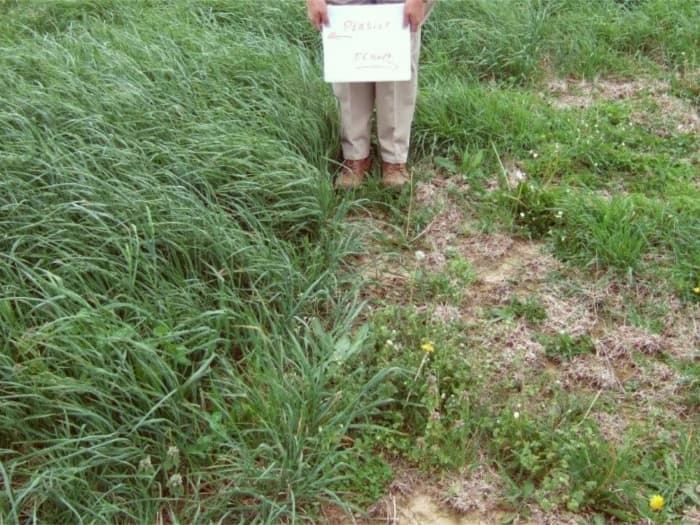
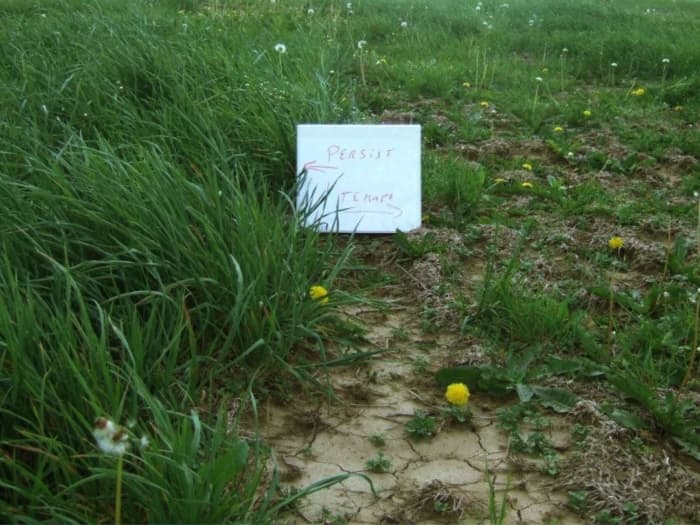
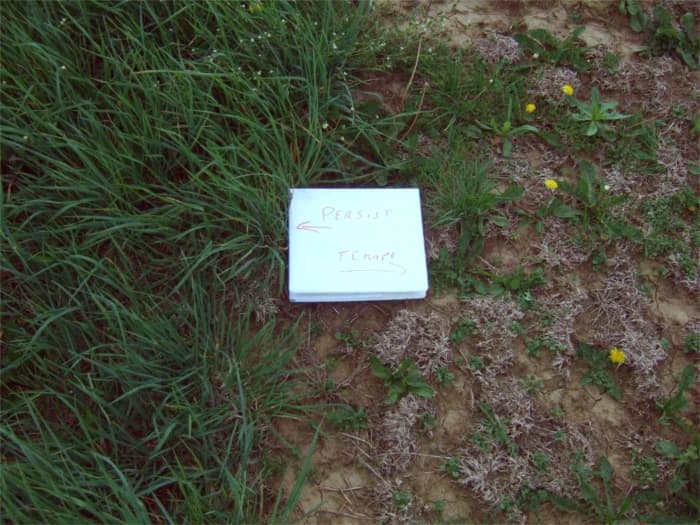
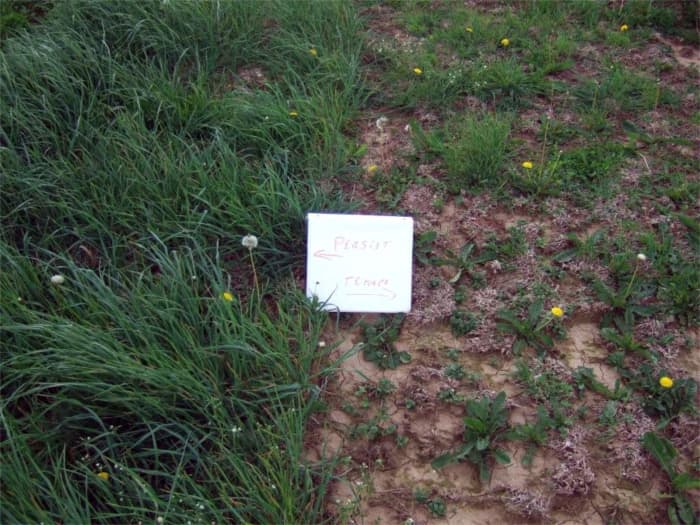
The following photos illustrate how Persist compared to some other varieties regarding performance through a very cold winter in Kentucky, including a winter that had a significant ice storm. The performance of Persist has been very good throughout the trial, as reported on the Grazing Data page.
Entering winter, multiple varieties still had decent ground coverage. That number has now been reduced. This past winter was very cold in KY, including an ice storm dubbed "the biggest natural disaster that (Kentucky) has ever experienced in modern history." The stress of grazing combined with the harsh winter simply has gotten the best of them. While Persist lost about 10% of its ground cover, the variety shown to the right of Persist lost FIFTY-FOUR (54%) of its ground cover. Ratings in the Fall of 2009 indicate that those plants never did come back.
Canada
In Canada, new forage varieties are required to have a certain amount of years of testing before they are approved for use. Part of the testing is to evaluate whether they are better than the existing varieties available. Persist was entered into such a set of trials in 2007. In January 2010, Persist was given the green light and is now on their list of cultivar selections for the challenging climate of the Maritime Provinces* of Nova Scotia, New Brunswick, and Prince Edward Island!
Here are some points to note:
- Persist survived - not all varieties do that!
- Persist had the HIGHEST second-year Mean Annual Yield** of all the trial entries!
- Persist was given the HIGHEST score for "2-year Persistence".
*Persist was tested at Charlottetown, Prince Edward Island; Fredericton, Nova Scotia; Woodstock, New Brunswick; Truro, Nova Scotia; and Old Barns, Nova Scotia.
**Mean Annual Yield is a particular calculation used by agrapoint.ca to compare varieties evaluated over different time periods in order to predict potential yields. Its purpose it attempt to accurately portray a variety's performance potential. A further clarification can be provided by agrapoint.ca.
Information used by permission of agrapoint.ca.
Cumulative Yields Summary
Eastern Canada
|Orchardgrass seeded from 1990-2007
| Cultivars | 3-Yr Mean Annual Yield** |
|---|---|
| Persist | 8.07 |
| Crown Royale | 8.07 |
| AC Splendor | 8.05 |
| Dactus | 7.91 |
| Kay | 7.91 |
| Intensive | 7.90 |
| Jay | 7.83 |
| Glorus | 7.80 |
| Artic | 7.70 |
| Niva | 7.69 |
| AC Nordic | 7.68 |
| Baridana | 7.67 |
| Okamidori | 7.67 |
| Okay | 7.64 |
| Lidacta | 7.59 |
| Frode | 7.45 |
| **Mean Annual Yield is a particular calculation used by agrapoint.ca to compare varieties evaluated over different time periods in order to predict potential yields. Its purpose it attempt to accurately portray a variety's performance potential. A further clarification can be provided by agrapoint.ca. | |